Center for best educational solutions
In the Moment Math Coaching Moves
Write your awesome label here.
The Art of the Nudge:
A Beginner’s Guide to
In-the-Moment Math Coaching
1. Introduction: Shifting from "Fixing" to "Coaching"
2. The Foundational Framework: Notice, Name, and Nudge
The "Quick Framing" technique allows a coach to process the complexity of a math classroom in sixty seconds or less, anchoring every suggestion in student work.
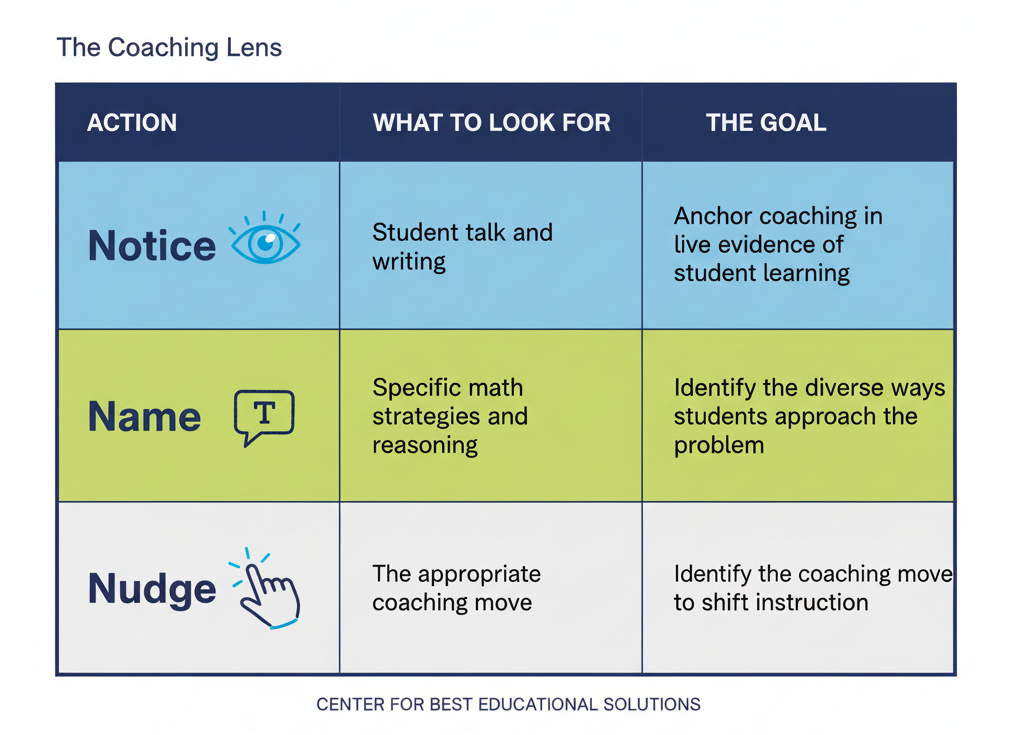
These three actions provide the clarity needed to execute five specific, high-leverage moves that improve student thinking without disrupting the lesson’s flow.
3. Five High-Leverage Coaching Moves for Math Classrooms
3.1 Move 1: Narrate the Math Thinking
3.2 Move 2: Feed the Teacher Questions, Not Answers
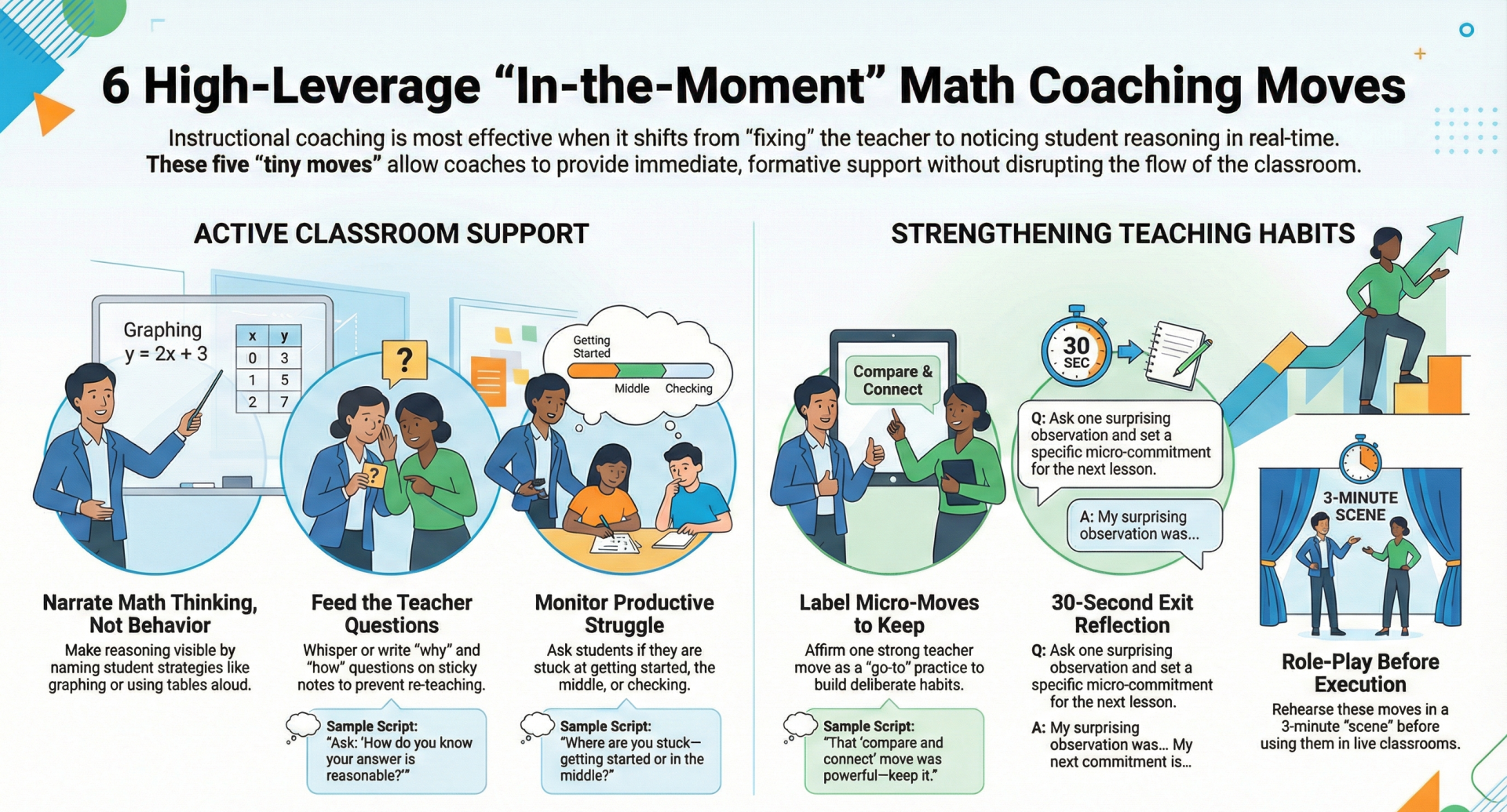
When a teacher is unsure how to proceed, resist the urge to re-explain the math yourself. Instead, provide the teacher with "what/why/how" questions that shift the heavy lifting back to the students.
3.3 Move 3: Prompt a Productive Struggle Check
To maintain high cognitive demand, coaches must help teachers facilitate productive struggle rather than rescuing students from it. This move ensures students remain the thinkers in the room.
The Strategy: Before providing a hint, prompt the teacher to have students turn and tell a partner: "Where are you stuck? Are you stuck at getting started, in the middle, or checking your work?"
Encourage the teacher to invite one student to explain the "stuck point" and another to suggest a next step, rather than providing the full solution.
Debriefing the Move: Ask the teacher: "How did that quick ‘where are you stuck’ question change what students did next?"
Debriefing the Move: Ask the teacher: "How did that quick ‘where are you stuck’ question change what students did next?"
3.4 Move 4: Name One Micro-Move to Keep
To build lasting capacity, a coach must identify a single, high-leverage action the teacher performed and label it as a deliberate habit to be repeated throughout the week.
• Example: "That was a great ‘How do you know?’ follow-up—label that as your go-to question for this unit."
• Example: "You just had students compare two solution paths—let’s name that ‘compare and connect’ and keep it as a deliberate habit this week."
Debriefing the Move: Ask the teacher: "If you did just that one move in every lesson this week, what might change for students?"
4. The Practitioner's "One-Pager" Cheat Sheet
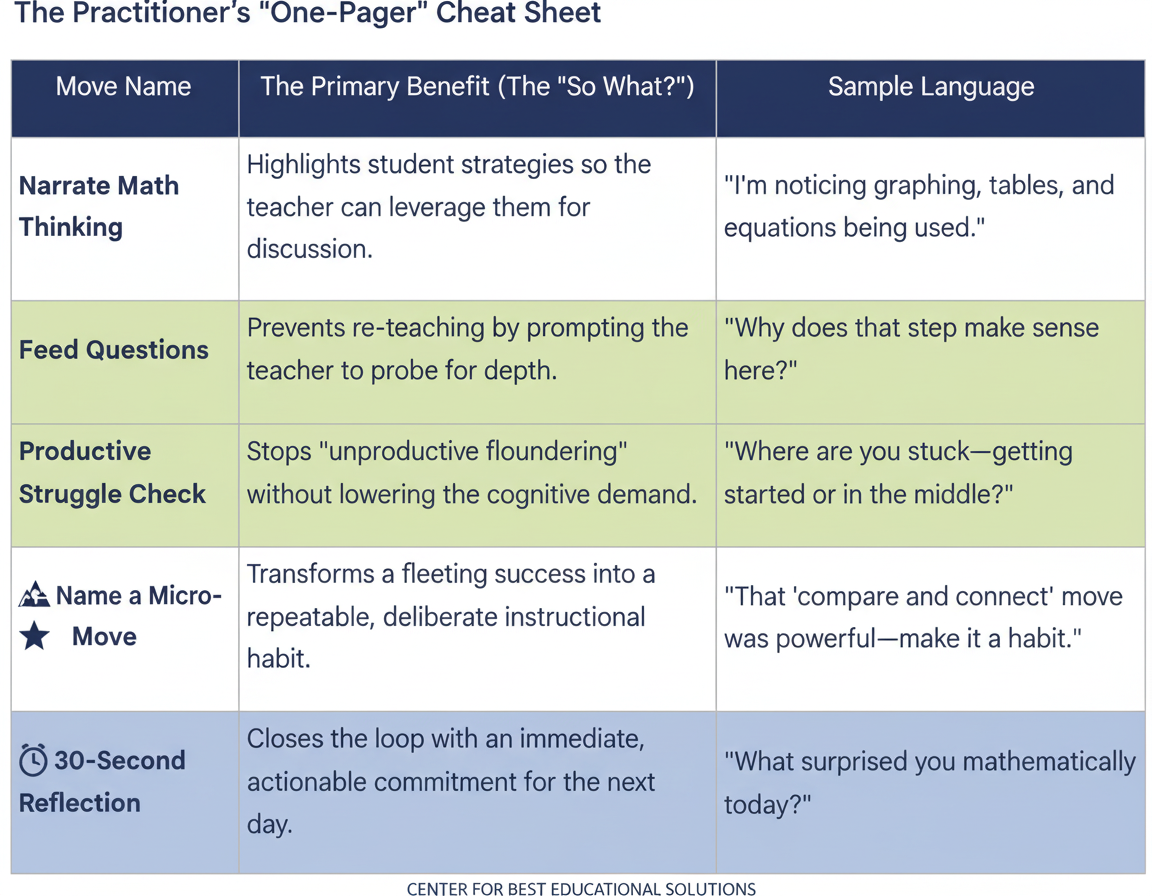
Effective preparation involves more than just reading these moves; it requires active rehearsal of the scripts and timing.
5. Putting It Into Practice: The 3-Minute Rehearsal
To make sure these moves feel natural, engage in a rapid, three-step rehearsal with a partner.
1. Set the Scene: Have your partner play the role of a high school teacher in the middle of a lesson on solving linear equations or quadratics. Describe a 30-second "scene" (e.g., "Several students are staring at their papers, stuck on how to set up the equation").
2. Role-Play the Interaction: While your partner "teaches," practice using at least two moves in real time. For example, hand them a sticky note with a "why" question, then quietly name a micro-move for them to keep.
3. Reflect and Script: Pause and ask: "Which move felt most natural? Which do you want to script onto a sticky note for your next classroom visit?"
By focusing on these tiny, in-the-moment "nudges," you build massive shifts in both teacher practice and student mathematical understanding.
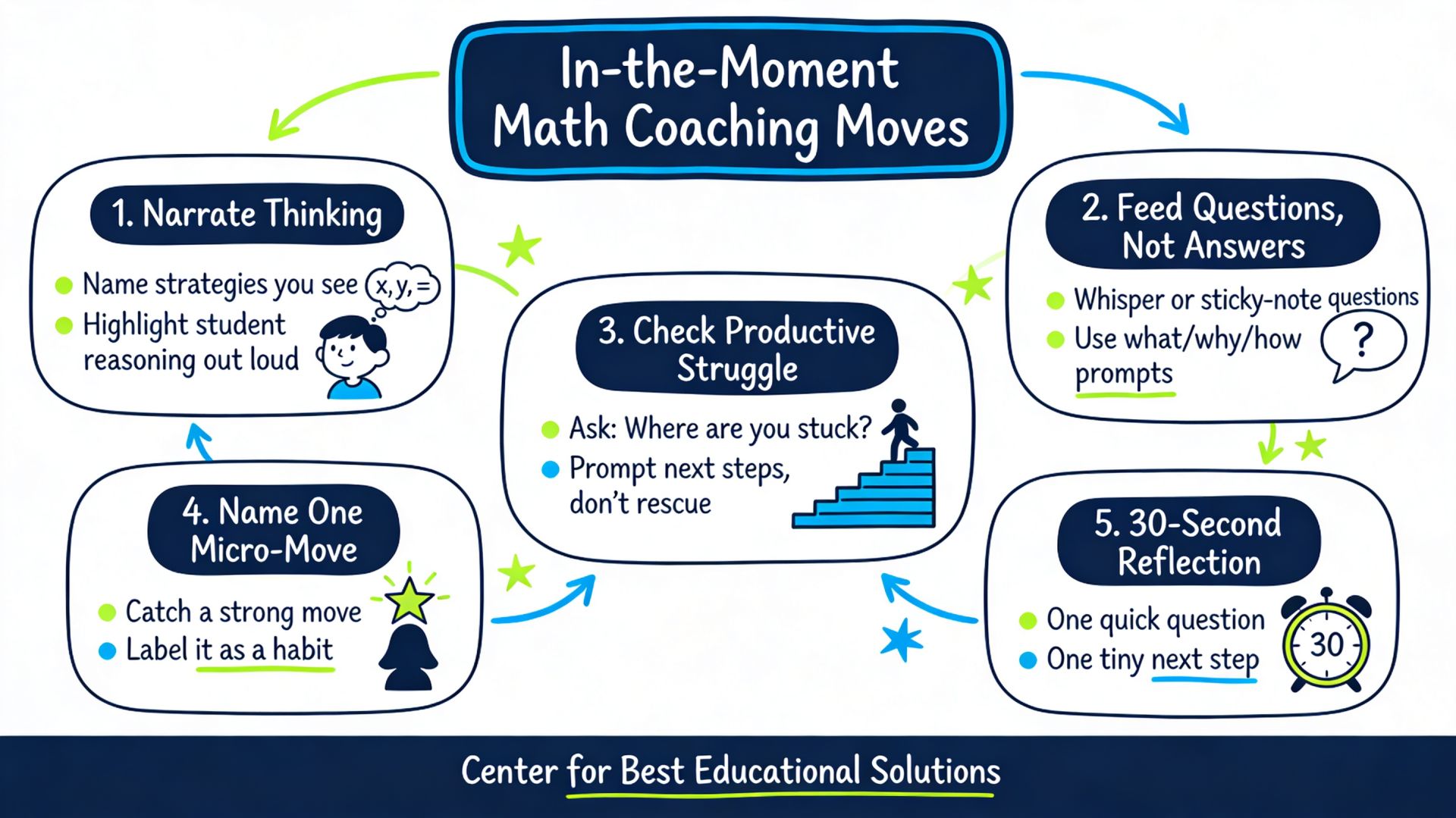
"Today let’s practice tiny in-the-moment moves you can use while you’re in classrooms: one to notice, one to name, and one to nudge."
Interested in More ?
Learn more about the possibilities.
In the Moment:
Math Coaching Moves
Here a few high leverage coaching moves with actionable tips that can be used with math teachers.
-
Adopt the "Notice, Name, Nudge" Framework: Anchor your coaching in "tiny in-the-moment moves" designed to notice what is happening, name it, and nudge the teacher forward
-
Shift the Lens from "Fixing": Instead of trying to fix the teacher, focus your efforts on coaching through "live formative assessment and questioning"
-
Narrate Math Thinking, Not Behavior: Call out the specific strategies students are using (e.g., "I'm hearing three different approaches: graphing, plugging into a formula...") to make student reasoning visible so the teacher can build on it.
-
Feed Questions, Not Answers: When a teacher is stuck, whisper or write questions they can ask students, such as "What did you do first?" rather than telling the teacher how to re-explain the concept.
-
Prompt for Reasonableness: Encourage the teacher to ask students, "How do you know your answer is reasonable?" to deepen understanding.
-
Check for Productive Struggle: To keep cognitive demand high without causing frustration, prompt the teacher to ask students exactly where they are stuck—getting started, in the middle, or checking work.
-
Encourage Peer Support: Advise the teacher to invite one student to explain a stuck point and another to suggest a next step, rather than providing the full solution
-
Name a "Micro-Move" to Keep: When you see the teacher do something effective, immediately label it (e.g., "That ‘compare and connect’ move was powerful") and suggest they make it a habit
-
Conduct a 30-Second Exit Reflection: Instead of a long debrief, ask one reflective question as students pack up, such as "What’s one thing students did today that surprised you mathematically?"
-
Set a Micro-Commitment: Close the interaction by co-setting a specific, tiny goal for the very next lesson, like using a specific question with two students
Never miss our news.
Subscribe to our newsletter!
Thank you!
Courses
Created with